

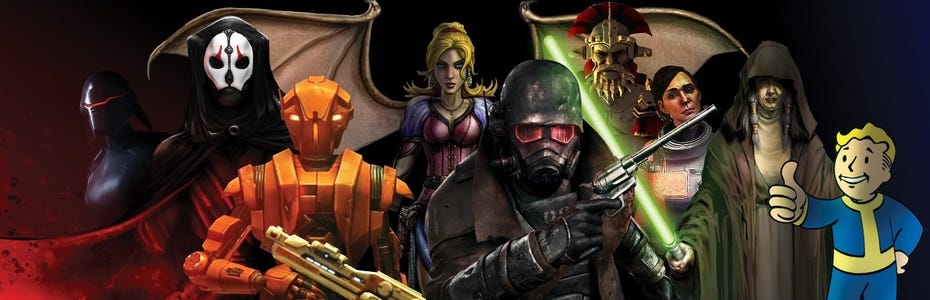
Chris Avellone’s characters have been around for decades. They have come alive; they have lived, changed, and died, even if they are still in circulation. You can play Planescape: Torment, Fallout 2 and Fallout: New Vegas, Star Wars: Knights of the Old Republic II, Prey, and several others. You can interact with his characters and bond with them. They will come alive when you play and engage with them, but the circumstances that kept them alive in popular culture are always changing.
This is the second part of our interview, where we delve into the life cycle of characters and how they endure in our imagination. In the first part, we saw how Annah from Planescape: Torment became emblematic of character complexity in CRPGs, influencing a generation of game designers, writers, and attentive DMs worldwide, beginning with my friend Max, who studied her lines.
In this second part, we’ll go over characters that come alive and yet never make it into the final game for a variety of reasons, all the minor characters that stand on the sidelines and never fully develop, and we consider, with a healthy dose of skepticism, the possibilities of character creation by AI models.
Worldwound Veterans
Avellone’s recent work credits (as per MobyGames) include Pathfinder: Wrath of the Righteous. Like most players, I was unaware of which characters were actually written by him, since there is no indication in the game itself, though he is included in the end credits. Apparently, his work was not used in the final version, but he was still acknowledged for his contribution.
On Wrath of the Righteous, I did a character summary, sample text, background etc. but the companion never saw the light of day. The companion was a “human” (but very long-lived 1001 years old) character that filled the Witch class role (which I believe was one of the new classes, so having a CNPC showcase that class for the player was a good idea), but she wasn’t a witch stereotype and even hated the word “witch.” She was previously serving as an infernal negotiator and contract drafter, had been there for ALL of the Worldwound crusades (so she could give a historical perspective on the current crusade), and had more of an all-business legal approach to most of her dealings with others. She had been at her job so long she had literally forgotten how to smile. She despised angels (hypocrites), tanar’ri (brutes), other races (annoying children), as well as most animals (including other humans) except for wasps, bees, and maggots. If you took the character Rebecca from Landman, aged her 20 years externally and 970-ish literally), that would be a good reference.
This is common practice in the games industry, where writers and designers get credit even for work that was not shipped in the game, and even if they don’t get paid properly for the work they did. Industry realities aside, this is how characters often die: on the page, before they become a set of game assets and files. It’s the spirit of what-might-have-been: anything that doesn’t make the cut and dies on the vine.
This isn’t Avellone’s first rodeo, but the good part is that even dead characters linger as ghosts haunting the writer’s mind. They seek to be part of a story somehow, and now this witchy non-witch will always haunt this abode of ours. Here at Blockhead, we welcome all characters, living and dead, but especially a legal spellcaster (not a “witch,” mind you) who likes only wasps, bees, and maggots. That’s the cincher.
Companions & Comrades
The games industry continues to be a difficult place for writers, even for a writer with Avellone’s experience. There is nothing left of his original work in the game, but at least he enjoyed collaborating with Alexander Mishulin and Andrey Tsvetkov for a while. Owlcat has expanded into a more corporate form since the game's release, which takes me back to my review of Kingmaker years ago for GameLuster.
I will say that the companion not seeing the light of day wasn’t all bad news: there had been other problems at that point because the executive producer at the time hadn’t been paying for work for several months (note that I had even kicked back money from the Kickstarter that was to go to me back to their company for the developers). So while some members of Owlcat were supportive (thanks, Andrey Tsvetkov), the end result was mostly a loss of time.
So aside from story reviews, feedback on companions and new plot additions, there shouldn’t be anything from me in the game I’m aware of. That said, I’m a big fan of Owlcat (Alexander Mishulin and Andrey especially), and I praise their success in the RPG space and wish them all the best in going ahead.
They did reach out again to see if I wanted to work with them again, but I mentioned my hesitations and recommended other writers they could try (who they didn’t contact, but I did want to give other writers a chance, since the industry is hurting nowadays).
Apart from these issues, I was more interested in learning how Avellone’s character writing continues to evolve since the early days when he made his name in RPG circles. What instincts created characters that endure and resonate? What new principles guide him now amid shifting team dynamics and design constraints?
So in character writing, there’s categories of characters: this is not a complete list, but they can be either basic NPCs, important NPCs, “town greeter” NPCs, merchant NPCs, companion NPCs (CNPCs), and a host of other categories. Of these all, companions can be the most difficult, and my design process for those I’ve summarized in a Pathfinder update you can find here.
There is no single purpose that fits all characters. Within all those categories, there are different approaches to character development. And with all of these contingencies and possibilities, the process leans on systems, classes, seasoning, lore and themes, but there are also regular characters with pragmatic purposes. Characters run the gamut from endlessly complex to flat, basic outlines that barely register.
Systemic Traits
Ultimately, characters must do something for the gameplay and the story at the same time. Some characters have a basic pragmatic purpose, such as merchants and shopkeepers, but they can still have something unique to them other than buying your junk. Obviously, companions have much more purpose tied to systemic features.
Systemic: Figure out what the character is there for. If it’s a merchant NPC, for example, you design them so players can access the store quickly (that’s why the PC is likely talking to them, not to hear their life story). For companions, you want a range of system advantages (and disadvantages) for the companion being in the party whether mage, thief, warrior, and so on – and they need to be systemically helpful and effective to the adventure, or else they’re going in the companion trash can. These system decisions also apply to having them support any new game system mechanics being introduced in the title – for example, is the character using a unique spell system or a brand new class that the game is trying out for the first time? Are you adding dual-wielding to the game, and you want a character to showcase a class that uses that art? These system decisions all factor in.
All of these special features usually lead to more individualized characters, with novel traits that bypass all the baggage of tropes and favourite races. There is an old story that Tolkien read passages from The Lord of the Rings to the group of writers Inklings, and one of them famously said during a reading: “Not another fucking elf!”
Class: Figure out what the character’s job is – a job is part of a character’s identity, and a “witch” profession has as big an impact on a character’s background as much as a “soldier” profession does.
Seasoning: This usually involves giving important characters a specific trait or specific item related to their personality. For Dak’kon in Torment, he had his karach blade that was representative of the chaos of his homeplane, but he also had a unique set of spells based on the religious text he carried with him.
Lore and Theme Purpose: How does this NPC relate to the theme of the game? It’s not necessary for every NPC, but it should always be asked for important NPCs. Is the character supposed to be representative of a certain faction or culture or point of view?
There’s a lot more elements beyond what I’ve listed here, but the Pathfinder update (esp. the example with Nok-Nok) might be helpful as well.
Annah was our focus in the first part of this interview, but this nod to Dak’kon also made me think that understated characters, who don’t share much of themselves, are often the most intriguing. Their reticence is enough to carry your interest. If they had a really convoluted backstory and were more open about it, they might lose the glow of mystery and untapped potential that they have with a more reticent personality.
Common Man
Finally, we come to the purpose of common characters, the interchangeable ones, the ones that appear often but have no significant role other than repeating their lines. We see them in every game, standing on corners, sitting in taverns, staring at nothing, moving in that way animated characters move, on a loop. But if they were not there, cities and places would feel less alive. If the Worldwound lawyer was stillborn, farmers and Dustmen are the opposite end: not special but essential for worldbuilding.
One thing I’ll add to this - there can be a temptation to make every single character in the world special. I’d argue that in an RPGs with hundreds upon hundreds of characters, you need to be careful with this, because you need the focus to be on certain events, a faction perspective or leader, and so on.
With this in mind, sometimes “run-of-the-mill” NPCs are actually serving a very important function by reinforcing some element of the culture they are in. As an example, if a farming village is being raided by bandits, you need some farmers to speak to it, and if you’re investigating the Mortuary in Sigil, you need some “baseline” Dustmen to provide the feel of the area, and so on. Even if these NPCs aren’t unique works of long-winded fraught personalities, they emphasize an area’s tone.
Even in KOTOR2, it was important for us to show that the people of the galaxy weren’t aware of the higher Light Side/Dark Side elements that were influencing the conflict and their lives… they quite understandably only saw the results of the war itself and the impact the Sith and Jedi conflict had on their lives. Showing the player that contrast, even in a simple way, can give the world more depth because it feels like something more grounded in human nature and “makes sense.”
Star Wars Knights of the Old Republic II: The Sith Lords (KOTOR2 for short) was perhaps the most cerebral Star Wars game of all time. As Avellone points out, leaving these characters on the margins of the struggle between the Light Side/Dark Side of the Force is an elegant way of making them matter as common folk. Their lines and traits are not complex, but they still played a significant role in the story.
AI and Its Discontents
We have all seen the firestorm around Larian Studios and Swen Vincke’s comments on generative AI placeholders in concept art for the pre-production of their new Divinity game. The studio later clarified its position, but there’s now a faction within the gaming world that seems ready to pounce at any studio or developer who even hints at incorporating AI models in any way in their development.
Many gamers have the capacity for nuance, but not all of us. As an aficionado of nuance as much as character development, I asked Avellone: How do we preserve the uniquely human in character creation amid these tools? Are there qualities like lived contradiction, moral ambiguity, human messiness, or player-specific empathy traits that AI can’t touch, no matter how good the data it’s been trained on?
Or perhaps vast datasets could potentially free writers and creators to innovate by surfacing novel elements more quickly? Avellone took a pragmatic view that avoids both extremes of the debate.
As long as you view A.I. as a tool, it’s not an issue. I do think Larian’s use of A.I. is nowhere close to some companies I’ve worked with, ones who have completely replaced the concept art phase wholly with A.I. I just think Larian was a bigger target, which I don’t think is fair.
Also, the issue with A.I. becomes worse when the A.I. is unnecessarily intrusive and seems to be being forced upon you – my writing has been impacted by copilot because I’m fighting it so much when using Microsoft Word, I can’t shut down and ignore its functions fast enough. Its “ever present” nature in the program has been frustrating.
As for the uniquely human character aspects, I will say that A.I. has the ability to draw on the exact same sources I did in creating Annah in Torment. Her construction was based on tropes I’d seen in the campaign setting, D&D in general, love interests in a wider context, tiefling origins, etc. So if an A.I. “mimicked” and used those same tropes, I suppose it could make the attempt at creating a character, but I don’t know how successful that would be. I doubt it would choose Sheena Easton for her voice, which probably says a lot for the importance of the human factor in creation. : )
That intrusion is where writers feel the worst of AI encroachment. Microsoft Word and every other word processor and writing tool on the market are slowly becoming infested with these writing aids. Soon, it might be impossible to avoid AI in all major operating systems and devices. Writers and designers who resist the rising tide might find themselves replaced by writers and designers who will be willing to use these tools, or at least to get paid for using them.
They can never fully replace characters and their unique voices. They might clone and tweak voices; they might couple them with custom-built language models for fluid dialogue mechanics, and so on. Yet if players don’t find these characters engaging and compelling, they won’t be thinking about them over twenty years later, not in the way we find ourselves thinking about Avellone’s characters and Sheena Easton’s voice.
Reports of the Death of Characters have been greatly exaggerated. Like actors, who find their livelihood more threatened than ever, the few loyal practitioners of the craft of writing and creating compelling characters will go on. Some might eventually warm up to AI-made characters, but we know only the ineffable human spark can captivate and move us, just as other humans can make us feel something.
I thank Chris for his usual generosity of spirit in this interview.